

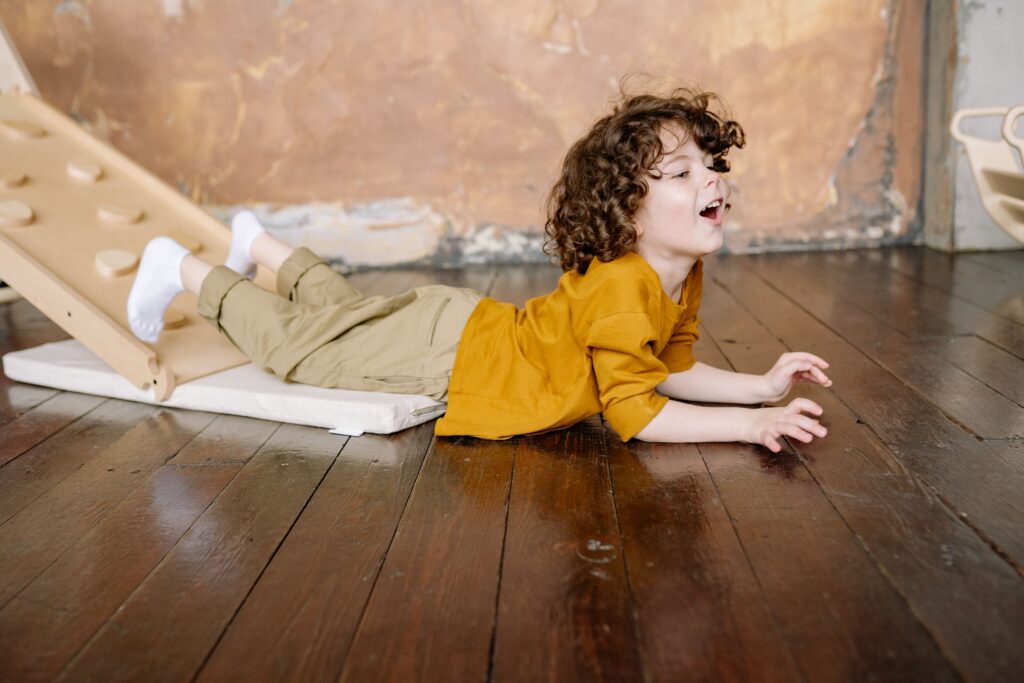
Understanding Children’s Behaviour: The Foundations
By Alexandria Parry, BAHS UK Senior Placement Specialist and Special Educational Needs (SEN) Specialist. This is the first article in our Understanding Behaviour series. In the coming articles, we’ll explore some of these areas in more depth, including why particular patterns of behaviour develop, emotional regulation and co-regulation, and how parents and professional caregivers can support children through challenging moments.
Behaviour is one of the main ways children interact with and respond to the world around them. It can tell us when something feels difficult, when a need isn’t being met, when expectations exceed the skills they have available in that moment, or when a child has learnt that a particular behaviour gets a particular response. Yet behaviour is rarely as straightforward as it first seems.
When a child’s behaviour changes or becomes more challenging, it is worth considering what else might be going on. Have they slept well? Are they hungry? Has something happened at school or with a friend? Has their routine changed, or have they simply had a particularly demanding day?
These questions won’t always give us an obvious answer, but they remind us that what we see on the surface is only one part of the picture.
The same behaviour can mean very different things for different children. A child who refuses to get dressed in the morning may be struggling with the transition ahead, avoiding something they find difficult, experiencing sensory discomfort or simply not wanting to stop what they are doing. They may also have learnt that refusing to get dressed delays the morning routine.
Equally, the reason may not be the same every time the behaviour occurs. Understanding behaviour isn’t therefore about finding one explanation and applying it to everything a child does. It is about building a fuller picture of the child, the behaviour and the context in which it is happening.
Behaviour gives us information
“Behaviour is communication” is a phrase we hear frequently, particularly when talking about children with additional needs. There is some truth in it, but I think it can sometimes be oversimplified.
Communication suggests there is a clear message being sent. In reality, children don’t always understand what they are feeling themselves, let alone have a particular message they are consciously trying to communicate.
A child who becomes distressed before school may not recognise that they are anxious, just as a child who lashes out at the end of a long day may not know that they are overwhelmed. The behaviour still tells us something, even if the child cannot tell us exactly what.
I find it more helpful to think of behaviour as giving us information. The challenge is working out what that information might be telling us.
This is where patterns become useful. A single incident rarely gives us the full picture, but over time we may notice that a behaviour happens more frequently during transitions, after school, when several demands are placed at once, or in particularly busy environments. We may also notice that the same behaviour is absent in other situations.
These patterns can help us understand what may be contributing to the behaviour, without assuming there is one simple explanation behind it.
“But they don’t behave like this at school”
Children’s behaviour can look very different depending on where they are and who they are with.
A child may cope well throughout the school day and then become highly emotional at home. They may behave differently with a nanny than with a parent, or struggle in one environment with something they manage well in another.
It can be tempting to see this as evidence that a child can control their behaviour when they want to. But behaviour changing across environments tells us something about the environment too.
Children often feel safer expressing a wider range of emotions and behaviours with the people they trust most. They may also have spent considerable energy meeting the social, behavioural and academic expectations of the school day, leaving them with much less capacity by the time they get home.
Rather than asking why a child can “behave at school”, it can be more useful to look at what is different between the two settings. Is there more structure? Greater predictability? Different expectations? More support? Do adults respond differently when difficulties arise?
The fact that a child manages something in one setting doesn’t make their difficulty in another any less real. The difference itself is information.
What happens around behaviour matters too
Understanding a child’s needs and emotional state is important, but we also need to consider how behaviour is shaped by what happens around it.
Children learn from what happens as a result of their behaviour. When a behaviour consistently leads to an outcome that works for the child, they are more likely to use that behaviour again. This process is known as reinforcement, and it can happen without adults realising they are reinforcing a particular behaviour.
For example, a child may become extremely distressed whenever an iPad is switched off. Their distress may be entirely genuine. They may find transitions difficult or struggle with the disappointment of a preferred activity ending. However, if crying or shouting repeatedly results in the iPad being returned, that response may reinforce the behaviour. Over time, the child learns that escalating when the iPad is removed can result in regaining access to it.
Importantly, the emotional experience and the learning process can exist at the same time. A child can be genuinely distressed by a boundary while also learning that a particular behavioural response can change the outcome.
Understanding why a child is struggling doesn’t mean every boundary needs to change. A child can find a transition genuinely difficult and still need to leave the park. They can be disappointed that screen time has ended while the boundary around screen time remains the same.
This is also where replacement behaviours are important. Rather than simply trying to stop an unhelpful behaviour, we need to help the child learn what they can do instead. For example, a child who becomes distressed or refuses a task when they need a break can be taught a more helpful way to ask for one.
The longer-term aim isn’t simply to reduce unhelpful behaviour, but to help children develop more helpful ways of navigating situations they find difficult.
Consistency creates predictability
The adults around a child form part of this picture too.
Parents, nannies and other caregivers don’t need identical approaches, but broadly consistent expectations and responses help children understand what to expect.
If one adult maintains a boundary, another negotiates when a child becomes upset and another removes the expectation altogether, the child receives very different information about what happens in response to their behaviour.
Consistency isn’t simply about adults presenting a united front. It creates predictability and influences what children learn over time.
This is particularly important when several people are involved in a child’s care. Parents and nannies may notice different behaviours or patterns depending on the situations they experience with the child. Sharing those observations can help everyone build a fuller picture and respond more consistently.
Building the bigger picture
There is rarely one explanation for challenging behaviour, just as there is rarely one strategy that will work for every child.
Behaviour may reflect a need a child cannot yet identify or communicate. The environment may be asking more of them than they can manage in that moment, a skill may still be developing, or previous responses may have reinforced the behaviour. Often, several of these factors are interacting at once.
Understanding this doesn’t mean that every difficult situation needs to be avoided or every boundary removed. Instead, it gives us a better starting point from which to consider what a child might need and what they may need to learn.
We won’t always know exactly why a child behaves in a particular way. Children are complex, and so is behaviour. But looking beyond what we see on the surface allows us to build a clearer picture, and that understanding provides the foundation for everything that comes next.
Related Blog Posts
Free Play: Why Stepping Back Supports Childhood Development by Hilary Adler
Fostering Artistic Curiosity in Children
Incorporating Meditation Into Family Routines
Talking To Children About Difficult Subjects
Mindfulness Book Recommendations for Children