The care continuum: matching setting to need
There is no one-size-fits-all when it comes to choosing the care setting for your elderly loved one. The choice will depend on your loved one’s medical needs, cognitive status, social preferences, family capacity, and financial situation — and the right answer can change as needs evolve.
The strongest placement decisions happen when families understand how in-home care fits into (and compares with) the broader landscape of care options.
Private in-home care
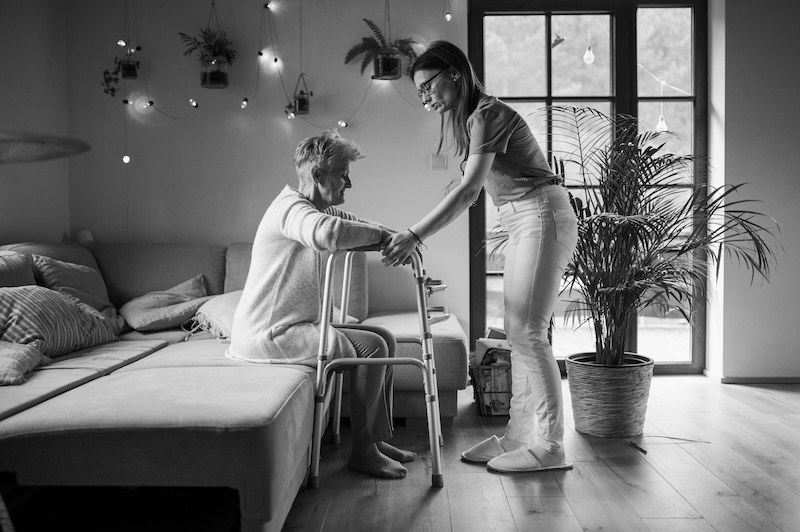
A caregiver comes to your elderly loved one’s home, whether they live alone or with family, and provides support ranging from companionship to hands-on personal care. At BAHS, this is what we do: place experienced, thoroughly vetted caregivers in private homes.
|
Advantages
- Allows the elder to remain in a familiar environment, preserving routine and independence
- One-to-one attention (care is tailored entirely to one person)
- Family maintains direct visibility and oversight of care quality
- Flexible (hours and scope of care can adjust as needs change)
- Strong evidence that aging in place improves quality of life and slows cognitive decline
|
Limitations
- Family becomes the employer (legal, payroll, and compliance responsibility falls to them)
- 24/7 coverage requires multiple caregivers and becomes costly
- No built-in peer or social community for the elder
- Caregiver turnover can disrupt continuity more acutely than in facility settings
|
Learn more about the different types of in-home care options in this section.
Facility-based care options
Although BAHS is here to help you find the right in-home care for your loved one, there may be a time when a move to a facility setting might be a better option.
In the US, facility-based care spans from largely independent living to 24/7 skilled nursing. It includes independent living communities, assisted living facilities (ALFs), memory care settings, skilled nursing facilities (SNFs), and continuing care retirement communities (CCRCs).
In the UK, facility-based care covers retirement housing, residential care homes, nursing homes and dementia care homes.
To help families understand these options and how they fit with your loved one’s needs, we’ve outlined the main types below, along with their closest UK equivalents.
Independent living (55+/retirement communities)
Housing designed for active, independent older adults. Meals, activities, and maintenance are typically included, but no personal care is provided.
In the UK, the equivalent sheltered housing/retirement housing provides community and security with emergency alarms and a warden available 24/7. Meals, housekeeping, personal care and maintenance are not included.
- A good fit when your loved one is independent but isolated or burdened by running their home
- Less suitable when your loved one needs personal care, medication management, or medical supervision
Assisted living facility (ALF)
A residential setting providing meals, housekeeping, personal care (bathing, dressing), medication management, and activities. Staff are on-site 24/7 but are not required to be licensed nurses.
In the UK, the residential care home is the closest equivalent to the US assisted living facility, with 24/7 personal care, medication management, and activities – staffed by care assistants.
- A good option when your loved one needs daily assistance but not skilled nursing, or if social connection and a sense of community are a priority
- Not a good fit if they have complex medical needs, require skilled nursing care, or are living with advanced dementia and require specialized memory care
Memory care
A specialized wing or standalone facility for people living with Alzheimer’s or other forms of dementia. These facilities offer a secure environment, structured routines, and staff trained specifically in dementia care.
In the UK, dementia care homes offer a specialist purpose-designed residential option with 24/7 care and staff trained in dementia support. For those living with additional complex needs as well as dementia, dementia nursing homes also offer on-site qualified nursing care.
- Worth considering if your loved one is at risk of wandering, has significant behavioral challenges, or has safety risks that cannot be managed at home
- Less suitable if they are in in early-to-mid stage dementia and are thriving with a dedicated in-home dementia-trained caregiver(s)
Skilled nursing facility (SNF/nursing home)
SNF offer 24/7 licensed nursing care for people with complex medical needs, those recovering after surgery, or needing end-of-life care. This is the highest level of facility-based care available.
In the UK, nursing homes provide similar care to the SNF in the US, with 24/7 care from registered nurses.
- A good fit if your loved one requires short-term round-the-clock care after surgery or a hospital stay, or when their medical needs have become too complex to be safely managed at home
- Less suitable when their needs can be safely met in the home, with the right eldercare professional or team
Continuing care retirement communities (CCRCs)
An all-in-one facility offering independent living, assisted living, memory care, and skilled nursing in one setting. As your loved one’s needs change, they can move between the levels of care. Although entry cost is often high, ranging from $100K – $500K+, many families value the long-term stability.
In the UK, there isn’t a direct equivalent to CCRCs. The closest option is a retirement village offering on-site care, with a spectrum of housing and care options. In these communities, your loved one’s care can evolve as their needs change. However, few retirement communities offer the full care continuum. Your loved one may need to move to another facility, such as a nursing home, if their care needs cannot be met on site.
Adult day programs
Adult day programs are not a residential option, but can be a valuable complement to private home care. Your loved one attends a structured daytime program with social activities, meals, and, in some cases, health monitoring and returns to their home in the evening. In the US, these programs are often partially covered by Medicaid and are a cost effective way to reduce caregiver fatigue and extend the support your loved one receives.
In the UK, adult day care centres offer similar programs and support to the US adult day programmes, with specialist options also available for those needing dementia or end-of-life care. As in the US, your loved one returns home at the end of the day. These services offer essential respite care for families and can be run by councils, charities, or private businesses.

When to choose private home care – and when to consider a transition
Choosing the right level of care is an important decision. Here’s how to evaluate the situation and what to consider.
| Situation or signal |
Recommended approach |
| Home care is the right fit |
Elder values independence and familiar environment; needs range from companionship to hands-on personal care; family can manage employer responsibilities; home is safe and accessible. |
| Home care with added support |
Elder has dementia or Parkinson’s but is in early-to-mid stage. Pair a specialist caregiver with adult day programming to manage cost, caregiver fatigue, and social engagement. |
| Evaluate a transition to facility care |
Safety incidents are recurring; the home cannot be safely adapted; significant wandering or behavioral safety risk; family is approaching burnout managing the employment side; family unable to ensure adequate coverage at home. |
BAHS is here to help you work out the right level of care for your loved one. If in-home care is the right fit, we will match you with caregivers suited to your loved one’s specific situation and needs. And if you are navigating a potential transition and feel uncertain, we are here to help you think it through, including guiding you in what to look for and what questions to ask.
FAQ
What is the difference between in-home care and a nursing home?
In-home care allows elderly loved ones to age in place, in their own home or with family. It involves one or more carers who visit or live in the home and provide support for medical or day-to-day needs.
How do I know if in-home eldercare is right for my loved one?
If your loved one wants to age in place, you can assess their needs to see if in-home care is an option. BAHS can walk you through the different types and structures of care and help you find the right level of support and the right carers.
What are some drawbacks of facility-based care?
Although many facilities provide excellent care, potential drawbacks include greater exposure to infectious diseases, high staff turnover, limited continuity of care, and less control over who supports your loved one. Residents may also receive less individualized attention and find the communal environment emotionally difficult, particularly when surrounded by others experiencing illness, pain, or distress.